
If you mention “amateur radio” or “ham radio” to the average person, they usually picture one of two things: an elderly person in a basement tapping out cryptic Morse code into the night, or intense hobbyists hunched over massive dials trying to rack up points in a radio contest.
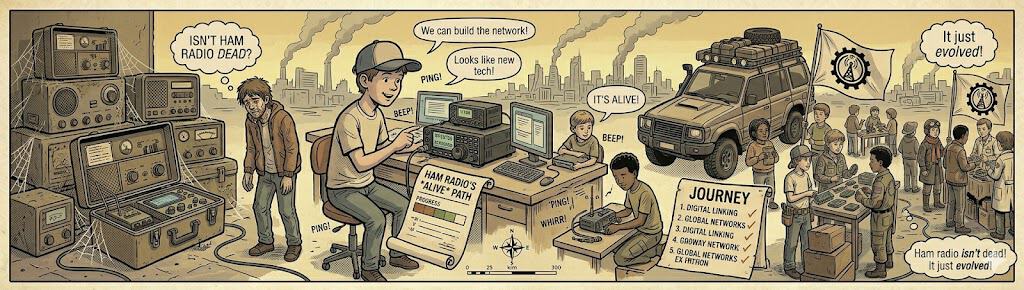
Because we all carry smartphones that can text someone across the globe in seconds, a frequent question pops up: “Isn’t ham radio dead?”
The short answer? Not even close!
In fact, the last ten years have seen a massive technological evolution in the hobby. Ham radio hasn’t been replaced by the internet and modern tech — it has merged with them. Today, it’s a dynamic, high-tech playground that bridges old-school analog physics with cutting-edge digital networking, off-grid exploration, and vital public service.
If you think ham radio is just a relic of the past, here is a look at what the hobby actually looks like today.
The Digital Evolution: It’s Not Just Voice Anymore
While traditional analog voice (AM, FM, and SSB) is still a foundational part of the hobby, digital modes have absolutely exploded over the last decade. Microprocessors and soundcard software have transformed what a radio wave can carry.
Text, Data, and Global Networks
- APRS (Automatic Packet Reporting System): This is a tactical, real-time data network. Hams use it to transmit GPS coordinates, weather station telemetry, track balloons with APRS radios and send short text messages over radio frequencies. It’s entirely independent of the cellular network.
- Winlink: Think of this as global, off-grid email via radio. By connecting a radio to a laptop, you can send and receive emails with attachments. It uses standard internet gateways when available, but can switch entirely to radio-to-radio relays if the Internet goes dark.
- Meshtastic: A newer, rapidly growing open-source ecosystem that uses license-free ISM radio bands to create decentralized, encrypted mesh text-messaging networks. It’s a great bridge for individuals looking into grid-down communication.
Digital Voice Protocols
Instead of listening to static-heavy analog signals, modern hams use digital voice modes that compress audio into data packets, offering crystal-clear communication and advanced routing:
- DMR (Digital Mobile Radio) & Yaesu C4FM: These protocols allow radios to transmit clear digital audio alongside data like call signs and GPS coordinates.
- Wires-X & Talkgroups: By linking digital repeaters to the internet, you can use a simple handheld radio to connect to specific “rooms” or “talkgroups” globally. You can talk to someone across your city or on the far side of the world with perfect digital clarity.
Moving the Shack Outside: Portable Operations
One of the biggest shifts in the last decade is that hams are escaping the basement “shack” and taking their gear into the wild. Portable operations have become incredibly popular, turning radio into an outdoor sport.
- POTA (Parks on the Air) & SOTA (Summits on the Air): These radiosport programs award points for setting up temporary, portable stations in national/state parks (POTA) or on mountain peaks (SOTA). Other hams “hunt” you from home. It keeps people active, hiking, and testing their ability to deploy antennas in the field.
- YOTA (Youth on the Air): Proving the hobby isn’t just for seniors, YOTA initiatives focus on getting the next generation hands-on with electronics, propagation science, and global communication.
- QRP (Low-Power Operating): While some hams use 1,500 Watts of power, a massive community thrives on QRP — running 5 Watts of power or less (about the power of a nightlight). Making a contact thousands of miles away on a battery-powered rig you carried in your backpack is an unmatched engineering thrill.
Overlanding, Off-Roading, and the Ultimate Lifeline
For the backcountry explorer, overlander, or 4×4 enthusiast, ham radio is an excellent addition to your vehicle build. Standard FRS/GMRS walkie-talkies are great for “around the campsite” chatter, but they lack the range and flexibility needed when things go sideways deep in the backcountry.
VHF/UHF vs. HF: Knowing Your Spectrum
Hams utilize different bands depending on the mission:
- VHF/UHF (Very High / Ultra High Frequency): Excellent for line-of-sight, crisp vehicle-to-vehicle chat or hitting local mountain-top repeaters that extend your range for hundreds or thousands of kilometers through linked repeaters.
- HF (High Frequency): These signals bounce off the Earth’s ionosphere, allowing you to communicate hundreds or thousands of kilometers away completely off-grid, without relying on line-of-sight or repeaters.
Backcountry Safety Protocols
When you are well beyond cellular coverage, ham radio serves as a decentralized safety net.
- The Wilderness Emergency Protocol (WEP): This is an established practice where users in remote areas monitor specific standard frequencies (like the national simplex calling frequencies) at specific times—typically every 3 hours starting at 7:00 AM, for five minutes. If someone is injured or stranded, they know exactly when and where to call for help, knowing someone is listening.
Purpose-Driven Radio: Public Service and Disasters
When normal infrastructure fails — whether due to a massive storm, a wildfire, or a cyber outage — ham radio frequently steps up. Hams are famous for providing disaster and emergency support when cellular towers lose power or become overloaded. Because amateur infrastructure is decentralized and privately powered, it doesn’t drop offline.
On a less dire note, hams also often provide vital public event support. If you’ve ever seen a marathon, a 100-mile cycling fundraiser, or an off-road rally, those communication checkpoints and safety nets along the remote course are often staffed entirely by amateur radio volunteers tracking participants and coordinates.
Then there is Field Day — an annual, weekend-long emergency exercise where thousands of hams across Canada and the US set up temporary stations using generators, solar power, and batteries to simulate operating under true emergency conditions. It’s part contest, part public demonstration, and part massive social gathering.
Space: The Final Frontier
If talking across the planet isn’t enough, you can look up. Ham radio operators regularly communicate with satellites orbiting the earth.
Even more incredible: the International Space Station (ISS) has a fully functional ham radio station on board.
Many astronauts are licensed hams. When they have downtime, they occasionally pick up the mic and talk to random operators back on earth as they pass overhead. Hams also regularly coordinate with schools, allowing students to ask astronauts questions directly over regular VHF radio waves as the station cuts through the night sky.
So, is ham radio dead?
Not by a long shot. It has evolved from a closed hobby of hardware builders into an expansive ecosystem of digital networking, outdoor adventure, and emergency resilience. Whether you want to ping a satellite, send an email from a remote mountain trail, or experiment with digital mesh networks, ham radio offers a passport to a world that exists entirely independent of commercial tech.
If you’ve ever been curious about how things work when the normal world goes offline, there’s never been a better time to study for your license and get on the air!